Vlad.V. Kamakin, Dr. Eng. 05.11.2022. Moscow, Russia.
In the memory of Prof. P. Ehrenfest and Prof. B.Kudrin
Annotation. On the example of cenoses – systems with a rank hyperbolic distribution of the features of constituent elements, the tsenamic method for controlling a complex system by changing the dimension of causal space is shown. Causal space is a set of significant factors that form the cause of the formation of a given system.
Keywords: tsenamic method for controlling the complex systems; creating cause; rank hyperbolic distribution; a change in the dimension of the causal space of the creating cause; cenosis elimination.
Further, a system is understood as a set of N arbitrary elements of several species with a common attribute having a rank distribution W(r), obtained as a result of the ranking procedure, when the numerical value W of a given attribute in elements of one species is put in accordance with the number r (rank) of that species in ascending order. Next, we will be most interested in a particular type of complex systems, the so-called cenosis.
The term «cenosis» was introduced by Carl Moebius in 1877 in biology to describe a community of organisms (biocenoses) inhabiting a shared territory. As a result of the ranking procedure, when the number of individuals of one species in a population is put in accordance with the number of that species in order of increasing number, we get a rank distribution of the number of individuals in the population. The study revealed an important feature — hyperbolic rank distributions are most often characteristic of stable forms. Such distributions look like a hyperbola (Fig.1.) and are described by the formula:
W=А/rβ, (1)
where W — ranked parameter, in this case — the number of species; A — the maximum value for a species with rank 1, i.e. in the first point; r — rank number of species; β — ranking coefficient, characterizing the degree of steepness of the hyperbola (for different cenoses 0.5≤β≤4.7) [1]
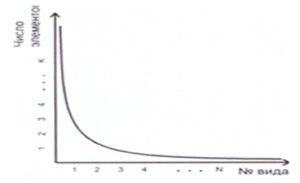
Fig.1. Hyperbolic dependence of the number of elements of a species on its number (rank).
Similar hyperbolic rank distributions (hereafter — the HRD or H-distributions) have been found in complex systems in nature and in structures representing various human activities.
One of them is called Zipf’s law, who first discovered it in linguistics (another name is Zipf-Mandelbrot law). This law is an empirical regularity of vocabulary application: so, if all words of a language (or just a sufficiently long text) are ordered by decreasing frequency of their use, the relative frequency of appearance of a word in such a list will, according to the formula (1), be inversely proportional to the ordinal number (rank) of this word (Fig. 2.):
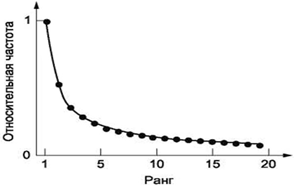
Fig.2.
Relative frequency of occurrence of words in the text depending on the rank.
For example, the second most frequently used word occurs about twice as often as the first, the third three times as often as the first, etc. As a result of Zypf’s numerous measurements, it was found that, although the experimental points deviate somewhat from those calculated by formula (1), in general all texts, regardless of language, author and epoch, behave similarly with respect to this dependence. It is noteworthy that integral semantic texts — linguocenoses, rather than a set of separate fragments — are subject to this dependence [2].
Recently, the interest in the study of systems with H-distribution has increased markedly. It has been proved that in many systems in animate and inanimate nature: social, economic, technical and others, it is HRD that serves as a sign of their capacity and stability [3]. Often this law is still called Zipf’s law, but its names vary depending on the branch of manifestation. In scientometrics, it is Bradford’s law (distribution of scientists by productivity); in bibliometrics, Lotka’s law (frequency of publications on a given topic in bibliographic sources); in economics, Pareto’s law (distribution of material goods in society); in social geography, Auerbach’s law (inequality of cities by population size); in technical systems, Kudrin’s law, which demonstrates H-distribution in technetics [4]. Among other things, HRD is also found in such distant fields as Internet sales (Chris Anderson’s rule) [5], economics [6], pedagogy [7], geology, astronomy [8] and many other fields. All systems with HRD are different from both deterministic systems (e.g., automobile, computer) and Gaussian probabilistic-statistical objects (gas in a tank). The former have rigid causal relationships and functional significance of their elements. If one of them fails, the system becomes dysfunctional. The second systems, Gaussian, on the contrary, have great independence and functional similarity of their elements (gas molecules, free electrons in metal, etc.). The systems we are considering are by their nature in a certain interval between the first and the second. Thus, unlike deterministic systems, they are stable to changes in the composition of the elements; unlike the objects of the second group, the internal connections of the elements are strong enough. These ties are not as rigid as in a deterministic system, and the freedom inherent in their elements is not as complete as, for example, in gas molecules. This peculiarity allowed all systems with the H-distribution to be classified as cenoses, and Professor B.I. Kudrin [4] suggested that the science of these objects should be called cenology. Cenoses can be divided into biogenic and abiogenic according to the type of constituent elements. Most of the above systems with HRD are examples of biogenic cenoses consisting of biological objects or structures that are the result of intelligent activity.
One historically significant example of biogenic cenosis is the composition of the Russian Council of People’s Commissars with a hyperbolic distribution based on the nationality of its members. So, of 15 members of the 1st Council of People’s Commissars in 1917 (Fig. 3): Russians — 7, Jews — 4, Ukrainians — 2, Poles — 1, Georgians — 1. Further, of 54 people who were members of the Soviet of People’s Commissars in 1917-1923 (Fig.4.): Russians -26, Ukrainians -10, Jews -6, Poles -4, Germans -3, Baltic -3, Armenians — 1, Georgians – 1


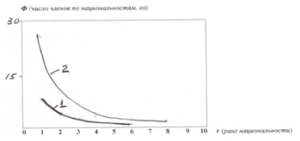
Fig.5. shows the hyperbolic distributions of 1 and 2 members of the Council of People’s Commissars of different years by nationality. Here we can see the remarkable ability of cenosis to manifest itself not only in the main, but also in indirect signs. Indeed, during the period of revolution and devastation, organizational and business qualities, not necessarily related to national characteristics, were more likely to be required of the members of the Sovnarkom. Meanwhile, judging by the presence of the HRD, this «national» cenosis occurred and could somehow influence the decision-making of the Sovnarkom.
Abiogenic cenoses, which exist mainly in inanimate nature, consist of objects of indirect matter. In a direct sense, the most striking example is the cenoses known in astronomy. Thus, it is established that a number of cosmic objects (solar system, galaxies, their clusters, etc.) represent astro- and cosmocenoses. Work [8] noted the presence of HRD of Galaxy stars on the surface temperature and concluded that our Galaxy is an abiogenous astrocenosis of size ~ 3∙1020 m.
In turn, in [9] the possibility of existence of systems with HRD at the other end of the size scale was shown. Namely, the existence of an abiogenic cenosis of size λ0 ~ 4∙10-13 m, formed by virtual photons around a solitary electric charge in vacuum. Here the distinguished feature, the number NΔ𝑝 of virtual photons with momentum Δ𝑝 , has a hyperbolic dependence on the distance r to the charge characteristic of cenosis:
NΔ𝑝 (r) =A/ r, where A is the corresponding constant.
The above examples show that the action of the causes of HRD in abiogenic environments equally leads to cenoses in the range of at least 35(!) orders: from ~ 4∙10-13 m in the microcosm to ~ 3∙ 1022 m in cases of astrocenoses. This brings cenology far beyond the scope of application only to optimize the state of cenoses of practical interest. B.I. Kudrin, in particular, assigns such a role to this discipline in technetrics — the science of completing the equipment of enterprises taking into account the cenological recommendations.
Meanwhile, among cenosis there are also dangerous species. These can be harmful biological, socially active systems [10] (colonies of micro- or macroorganisms, religious sects, criminal communities, etc.), which can cause damage both to an individual and to society as a whole. Like all cenoses, they are characterized by a high degree of resistance to external influences and destructive factors. Combating systems of this kind requires special approaches and methods. We hope that the so-called cenomic method of cenosis management proposed in this work will become an effective means of combating this kind of harmful systems.
Turning to the essence of the matter, let us consider the process of cenosis emergence in general and introduce a number of definitions.
1.We believe that cenosis, both biogenic and abiogenic, arises as a consequence of a multifactorial phenomenon — a creating cause (CC)which transforms an initial amorphous set of N elements into a structured system with a hyperbolic ranker distribution (HRD) of the characteristics of the same elements. From the set of factors forming this cause, we single out the significant ones — the most essential for the creation of a cenosis. Naturally, for each cenosis in its environment there is its own creating cause due to the action of significant factors peculiar to it.
For example, for the creating cause of the previously mentioned linguocenosis, the literary text, are important factors concerning peculiarities of the language and technique of the work; the professionalism of the author intending to write the conceived text; the author’s intention, agreed with various, for example, financial structures; organizational or other (domestic, financial, etc.) possibilities of the author to realize the conceived; the availability of a publishing house, ready to work with the author on agreed terms;
There can be many such factors. Let us especially note their possible mutual independence from each other. For example, the readiness of a publisher to cooperate with an author is not necessarily related to the marital status or physical data of the latter, etc. The totality of factors significant for the formation of cenosis forms the so-called Causal space (from the Latin causa — cause), or C-space of the creating cause of cenosis.
Definition 1. The Creating cause (CС), due to which the cenosis appeared, is the result of the action of many heterogeneous significant factors — objects of the so-called Сausal space (С — space) of the given CС.
2. We say that C-space of the CC has n dimensions if a set of factors — objects of this space — can be divided into n independent subsets, each of which contains only homogeneous (in kind, type, dimension, etc.) factors.
Thus, the heterogeneous objects of the C-space of the CC of the mentioned linguocenosis can be concentrated in, say, three independent «dimensions»:
«literary» — author, language, erudition; availability of plot, etc.; «domestic» — working conditions, accommodation, family situation, etc.; «organizational» — financial condition, relations with publishers and other structures, sponsors, etc.;
The importance of the parameter n is obvious: the absence of at least one of the dimensions, for example, «literary», in the C-space of a given CC clearly prevents the emergence of linguocenosis.
Definition 2. We say that C-space of the CC has n dimensions if the set of heterogeneous significant factors included in it can be concentrated in n subsets (dimensions) containing homogeneous (in form, type, dimensionality, etc.) factors.
It follows from the above that all the properties of CCs related to the creation of cenoses are determined by the structure of C-spaces including the factors significant for this purpose. The fact that all CCs, acting in different environments, show the same ability to create cenoses allows us to assume the presence of a certain common property in C-spaces of all CCs that determines this ability. This assumption can be formalized as our accepted Postulate:
The ability of CCs to create cenoses with HRD in their environments
is caused by the presence of the same property in the structure (2)
of all C-spaces, conditioning this ability.
Since, according to the meaning of Postulate (2), the above property is inherent in C-spaces of CCs of all cenoses, and, consequently, of the same linguocenosis, we can find out what exactly it manifests in the C-space of the latter.
The subject matter of the linguocenosis is the author’s language. The statement about the three-dimensional space of the language of literary works, based on the opinion of one of the leading linguists, acad. Y. Stepanov, who in his work: «In the three-dimensional space of language» [11,12], imagines language, if understood from the position of semiotics, in three dimensions: «as a space or volume in which people form their ideas». According to Y. Stepanov, the study of language in linguistics, philosophy and the art of words is directed along the three axes along which the description of language in semiotics goes — syntactics A, semantics B and pragmatics C, where (briefly):
Syntactics A — is a section of linguistics that studies the semantic meaning of language units (e.g., the alphabet);
Semantics B — is a section of linguistics and semiotics which studies the relations between signs within a sign system. The subject of semantics, in particular, is the combinability of signs, the rules of construction of sign expressions (meaning and significance of words, phrases, etc.);
Pragmatics C (simplified) — a set of conditions of use of language signs and rules.
By its nature, the purpose of linguocenosis is to convey to the consumer the semantic information contained in the text, defined (by Yu. Stepanov) by three ABC-groups of significant factors, constituting, in accordance with Definitions 1, 2, the causal ABC-space of CC linguocenosis with dimension n = 3.
Let us estimate the value of the value of n for the existence of linguocenosis by increasing, for example, the dimensionality of C-space to n = 4 by adding the fourth dimension k to ABC dimensions. Let us consider the functional change of linguocenosis when replacing the 3-dimensional causal ABS-space with the 4-dimensional causal ABCk-space by the example of a text from an English folk nursery rhyme «This is the House That Jack Built»:
«This is the house that Jack built.
This is the malt that lay in the house that Jack built.
This is the rat that ate the malt
That lay in the house that Jack built.
This is the cat that killed the rat
That ate the malt that lay in the house that Jack built.
This is the dog that worried the cat
That killed the rat that ate the malt
That lay in the house that Jack built…»
To demonstrate the features of lingvocoenosis in a given text, let’s carry out a procedure of ranking some words by frequency of use W and plot the dependence of the frequency W(r) on the rank of the word r (Fig.6.):
Word Rank Frequency
That 1 14
House 2 5
Cat 3 3
Dog 4 1
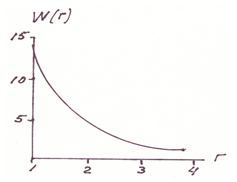
Fig.6.
Rank hyperbolic distribution of frequency W (r) of word usage.
As a result of the ranking we are convinced that this text has signs of linguocenosis (Fig.6) with a hyperbolic rank distribution:
W(r) = 14/r (3)
The text of this cenosis, written in the letters of the English alphabet (syntactics AE), carries semantic information understandable to a native speaker (semantics B), which, in principle, allows its practical use (pragmatics C). To increase the value of n we introduce a fourth dimension into the three-dimensional causal (AEBC) — space with syntactics AE (English alphabet) as a second syntactic — using, for example, the Greek alphabet (AG) along with English. In the new four-dimensional (AEAG BC) space the former text can look differently. Everything depends on the arbitrary ratio of the number of characters of the used alphabets AE and AG. The AE/AG ratio can be chosen so that the cenosis’s ability to convey semantic information will be completely lost. As an example, let us compare variants of the second line of the poem with equal use of alphabets (AE/AGvalue ~ 1) for dimensions corresponding to two values of n:
for n = 3 — (AE BC) — This is the malt that lay in the house that Jack built.
for n = 4 — (AE AG BC) — Tμεs ψω τe mφωt tβχt lβα iχ tωe χoετe tλat Jaτk ψβlt.
It can be seen that increasing the dimensionality to the value of n = 4 by introducing the fourth dimension in the form of letters of another alphabet, leads to the loss by the lingvocenosis of the function of transferring semantic information and thus is a sufficient condition for the liquidation, at least, of this type of cenosis.
Let us check the conclusion about the significance of the condition n = 4 for liquidation by the example of another, now abiogenous cenosis from the field of astronomy — our Galaxy. As it was noted, a number of cosmic objects are astro- and cosmo- cenoses according to the distribution of values of some attributes. Observed data on the rank hyperbolic distribution of our Galaxy’s stars by surface temperature (Fig.7) allow us to conclude that by this parameter the Galaxy is a giant astrocenosis of size ~ 3∙1020 m [8].
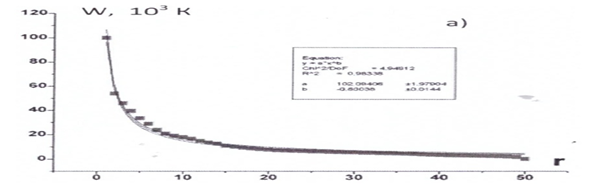
Fig.7.
Rank hyperbolic distribution of stars in the Galaxy by surface temperature W, 103 K; r is the rank of the stars subclass [8].
The gravitational force F, leading both to the appearance of stars (gravitational contraction of the initial matter) and their motion around the galactic center, according to Definition 1, can be considered as the CC of the astrocenosis. The significant factors of this CC, forming the C-space, we find from Newton’s Law of Universal Gravitation:
F = G ∙ m1 m2 ∙ r -2,
where the input quantities (in the SI system) have dimensions: gravitational force F [kg ∙ m ∙ s-2], gravity constant G [m3∙ kg-1∙ s-2 ], gravitational masses m1, m2 [kg], distance r [m].
The CC of the astrocenosis, gravitation, is determined by the values of three heterogeneous factors independent of each other:
«mass» — M [kg], «time» — T [s], «distance» — L(3)[m],
according to Definition 2, forming the three dimensions of the C-space of this CC.
That said:
1.The factor «mass» is presented in nature in two kinds: M — for objects from ordinary matter and M* — for possible objects from antimatter. These types are alternative, because when they come into contact within the same system, an annihilation reaction occurs. Observations show that antimatter on a large scale is not seen in the Universe.
Nevertheless, since gravity, as the creating cause, equally acts on M and M*, it is theoretically possible to have astrocenoses of both matter and antimatter.
2. The time factor T is a measure of the duration of processes taking place.
3. Distance L(3) is a measure of movement of objects in three-dimensional physical space.
Since the gravitational interaction force for M and M* is the same and is determined by the values of the three factors listed above, it can be stated that the condition for creating astrocenoses is the dimension n = 3 causal spaces: MTL(3) for a CC astrocenosis from substance M and M*TL(3) for a CC astrocenosis from antimatter M*.
Let us find out how a change of dimension n, say, an increase to n = 4, affects the «ability» of gravitation to create an astrocenosis. Since we are talking about astronomical objects, the measures proposed below are purely speculative.
Let us consider two cases:
During formation of astrocenosis, an equal amount of antimatter M* is introduced into the gravitational action zone together with matter M, thus transferring the creating cause from the 3-dimensional causal space MTL(3) to the 4-dimensional causal space MM*TL(3). This procedure deprives the gravitational force of the ability to create astrocenosis because of the annihilation reaction when matter comes into contact with antimatter. Thus, when C-space of the gravitational force passes to dimension n = 4, the astrocenosis is not formed.
2. Increasing the dimension n by changing the factor L(3).
We are talking about the mental transition from the three-dimensional physical space L(3) of astrocenosis localization to the physical space of higher dimensionality L(3, k). In this case the dimensionality of causal MTL(3) space n = 3 increases to n = 4 for causal MTL(3)k-space (at k = 1). The influence of the dimensionality of physical space on objects, forces and types of motion is considered in the article of P. Ehrenfest (1880-1933) «How in …. laws of physics is shown that space has three dimensions», where it is proved that the substance in complex form (molecular, atomic, etc.), as well as the stable motion in the central force field are possible only in three-dimensional physical space. The article content can be found in [13]. Let’s note the main statements:
1.On the example of the Bohr model of the atom in n-dimensional space Ehrenfest showed that atoms lose stability at dimensional space n ≥4 since electrons move to more and more distant orbits, i.e. spontaneous ionization of the atom occurs. Subsequently other authors have obtained a more accurate solution of the hydrogen atom spectrum problem (using solutions of the Schrödinger equation) which, although different (at n≠3) from Ehrenfest’s data, also leads to «instability» of the atom for n≥4 (the electron must spontaneously fall on the nucleus) and to «superstability» of the atom for n≤2. Thus, the substance (factors M and M* of the dimension «mass» of causal space), as the basis of astrocenosis elements, is able to exist only in three-dimensional physical space.
2. Further, considering «physics» in the n-dimensional Euclidean space En, Ehrenfest derives the law of interaction with the point center (similar to the three-dimensional case) from the Poisson differential equation in En for the potential determining this interaction. The author proceeds from the invariability of the general law of interaction, from which, as a corollary, one can obtain the law of interaction not only of two point particles, but also of any system of arbitrary shape and density distribution. Ehrenfest also subordinates motion to Newtonian laws of dynamics, or rather their natural generalization to the case of En.
Based on such laws of interaction and motion, we consider, in particular, a consequence important for us: the closedness and stability of orbits of objects in the field of the center of gravitational attraction at distance r from this center. It turns out that only in three-dimensional space E3 (in our notation, L(3)) both a stable finite (always with closed trajectories) and infinite motion are possible. Recall that the finite motion is the motion corresponding to changes of the radial coordinate r within a finite range 0 < r1 < r < r2; whereas in space E2 (we here this — L(2)) only finite motion is possible, and only circular trajectories are closed.
In the space of dimension n > 3 the finite motion corresponds only to circular trajectories and moreover it is always unstable, i.e. any small perturbation leads either to a fall to the center or to a removal to infinity. Indeed, in the spherically symmetric case in En from the Poisson equations for the potential follows an expression for the potential energy V (in the Ehrenfest notation):
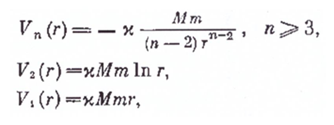
where M and m are gravitating masses, and ϰ is the interaction constant. These expressions for the potential energy in n-dimensional space correspond to the expression for the interaction force:
Fn (r) = ϰMmr 1-n
Thus, with the exotic possibility to change the dimensionality of physical space in the area of astrocenosis localization, we could talk about a way of its elimination by transition from three-dimensional MTL(3) to four-dimensional causal MT L(3) k — space by adding to the three dimensions of physical space L(3) the fourth spatial dimension — k (at k = 1).
The considered examples show that the dimension n = 3 of C-space serves as a the ability of gravitation to create astrocenoses, which is lost when the dimension n = 4 is increased. This result is applicable to C-spaces of all abiogenic cenoses, because the values of significant features in any system of units (SI, etc.) are defined in the same MTL(3) dimensions. Moreover, within the framework of the accepted Postulate (2), the obtained result can be extended to the C-spaces of CC of all cenoses. In this connection the following Hypothesis is valid:
Cenosis c is formed by the action of a creating cause (CC)
defined in the causal space with dimension n = 3, ( 4) the increase of which up to n = 4 deprives the CC of the
ability to create cenosis.
Accepting this hypothesis, we consider the value of dimension n = 3 as the required property of C-spaces of all CCs capable of creating cenosis, and n as the parameter sufficiently determining this ability. Here we talk about the sufficiency of the influence of the parameter n because we do not exclude the presence of other features of the structure and properties of C-spaces that also affect the ability of CCs to create cenoses. It is sufficient for us that the introduction of the fourth, «conflict» dimension into the three-dimensional C-space and thus bringing the value of this parameter to n=4, leads to cenosis decay and can serve as what we call a tsenamic way to control the state of cenosis. Including for the purpose of eliminating the latter.
The three (basic) dimensions of the C-space necessary for the creation of cenosis let’s define it as: α, β, ϒ. The fourth, «conflict», dimension we denote by «k» (Fig. 8):
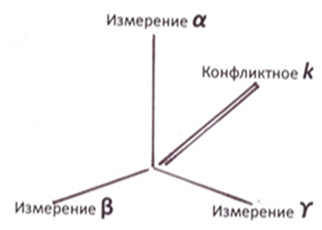
Fig. 8.
3-dimensional (αβϒ)-causal space for cenosis with «conflict» k.
Fig. 9. shows a way of eliminating cenosis by introducing a fourth, «conflict», dimension α*, qualitatively similar, but essentially alternative to one of the three basic ones, in this case — α.
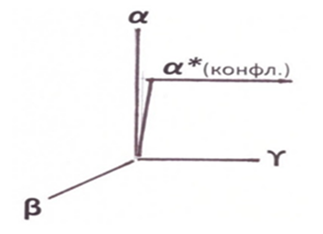
Fig. 9.
The conflict dimension α* is qualitatively similar, but alternative to the dimension α.
In the above examples, the role of the «conflicting» α* was played by factor k, qualitatively similar to L(3), and factor M*, alternative to M.
All of the above was applied to the cenoses whose ordering consisted in the presence of the corresponding HRD. However, it can be shown that the proposed method is applicable to the management and elimination of systems with an arbitrary degree of ordering. For this purpose, let us introduce the following notions:
1. Aggregate — an unordered cluster of N arbitrary, unrelated objects.
2. System — any ordered cluster of N interconnected objects.
3. Aggregate changes into a System state under the action of a creating cause (CC)that exists in its C-space.
4. System returns to the state of Aggregate when the creating cause ceases.
Two examples of Aggregate and System consisting of N elements:
Aggregate — N random passengers in the subway car.
System — N fans — teammates in the club bus
Let the information entropy, which characterizes the degree of disorder in the aggregate, be E0. The appearance of any degree of orderliness in a given set of elements transfers the latter to the state of a system, thus reducing the informational entropy to the value Es. The transition is accompanied by the flow of information Is proportional to the difference in values (E0 — Es) :
Is = k (E0 — Es) > 0 , where k is the proportionality factor. (5)
In turn, it is known [14] that the amount of any information, as in the particular case of linguocenosis, is determined mainly by the three independent measures noted above: syntactic, semantic and pragmatic, denoted here, as before, by A, B, C with more general shorthand characteristics:
syntactic measure (A) — operates with an impersonal component that does not express a semantic relation to the object. In the framework of probabilistic approach, syntactic measure of information quantity is determined by the degree of change in uncertainty of the system state;
semantic measure (B) — is used to characterize information in terms of its meaning. The semantic information measure can be a coefficient of content, defined as the ratio of the amount of semantic information to its total volume;
pragmatic measure (C) — characterizes the usefulness (value) of information to achieve the user’s goal. This measure depends on the needs of the user and the course of the information process.
Since in accordance with (4) the process of transition of an Aggregate into a System occurs at any positive value of Is, we have the right to consider this information as acting in 3-dimensional causal ABC-space creating a cause not only for cenosis with sufficiently high ordering related to the presence of HRD, but for any systems with Is > 0, for which increasing the C-space dimension to n = 4, stops the creating cause, which leads to the liquidation of the system. As a result, let us reformulate Hypothesis (4) in a more general treatment:
A system of ordered elements is formed by the action
of a creating cause defined in a three-dimensional (n = 3) (6) causal space, an increase in the dimensionality of which up
to n = 4 leads to the elimination of this system.
It follows from Hypothesis (6) that in order to liquidate any ordered system by the tsenamic method, it is necessary to define three (or at least one!) dimensions of the C-space of the creating cause in order to form the fourth, «conflict» dimension, whose introduction into C-space according to schemes Fig. (8,9) will liquidate the system. Let’s note that application of this Method for elimination of complex systems is not a simple task, it requires evaluations of branch experts and wide interdisciplinary discussion.
List of references:
1. Puschin S.L. Pricing is Simple. Vyp. 45. «Pricing Studies.» — Moscow: Technetica, 2010. — С 12.
2. Kudrin B.I. My seven distinctions from Zipf //General and Applied Pricelogy. — 2007. — № 4. — С. 25-33.
3. Delas N.I., Kasyanov V.A. Non-Gauss Distribution as a Property of Complex Systems Organized by Type of Cenoses. // East-European Journal of Advanced Technologies. — Kyiv, 2012, №3(4). — С. 27-32.
4. Kudrin B.I. Introduction in Technetics. 2-th ed. revised and supplemented — Tomsk: Publishing house of Tomsk State University, 1993. — 552 с.
5. Anderson K. The Long Tail. The new model of doing business. Moscow: Vershina, 2008. — 272 с.
6. Fufaev V.V. Economic cenosis of organizations. — Moscow-Abakan: Center for System Research, 2006. — 76 с.
7. Gurina R.V. Rank Analysis of Pedagogical Systems (Pricing Approach) [Text]: Methodological Recommendations for Educators / R. V. Gurina. — Moscow: Technetica, 2006. — 40 с.
8. Gurina R.V. Cosmic systems as astrocenoses/ Pricing modeling: theoretical foundations and practical results. Proceedings of the XVth conference on philosophy of technology and technetica and the workshop on cenology. Vol. 47. «Pricing Studies.» — Moscow: Technetica, 2011. — С. 178-185.
9. Kamakin V. V. On the spatial scales of the objects of cenology. Site «Tsenamika».
10. Organizations banned on the territory of Russia. https://minjust.ru/ru/nko/perechen_zapret.
11. Stepanov Y.S. In the three-dimensional space of language (Semiotic problems of linguistics, philosophy and art). — Moscow: Nauka, 1985. — 335 с.
12. Morris C.W. Foundations of the Theory of Signs // Semiotics. Semiotics. ed. by Y.S. Stepanov. — Moscow: Raduga, 1983. — С. 38.
13. Gorelik G.B. Why is space three-dimensional? — Moscow: Nauka, 1982. — 170 с.
14. Lidovsky V.V.. Theory of information. Sputnik Company. Moscow: Kompaniya Sputnik. 2004. С. 111.4
